In an earlier blog-post, I explored the institution of the "Grand Tour," an extended trip through Europe to engage with the classical heritage of Italy, considered as an essential element of the education of an aristocratic young man through most of the 18th Century. Each grand tourist chose his own itinerary, in consultation with his father, friends and tutors: a few lingered in the Alps; many stopped to draw and paint the scenery; some continued south from Rome, to Naples and Sicily. Often, they were away for more than a year, and costs inevitably mounted.
There were a great many families who considered themselves "gentle-folk," but could not afford a Grand Tour in continental Europe. An idea arose, among these people of the "middling sort" (country parsons; men who had served as officers in the army or navy, who owned land, but not vast estates; men who ran businesses, but had not yet risen into the ranks of the industrial plutocracy), that similarly edifying and educational experiences might be obtained closer to home.
William Gilpin (1724-1804) was born in Cumberland, the son of an army captain. His brother became a professional painter, but William opted for a career in the Church, graduating from Oxford in 1748, and later becoming Headmaster of Cheam School. Certainly he could not afford a Grand Tour, and nor could he amass a significant art collection, but he nonetheless aspired to the connoisseurship that, in large part, defined a "gentleman." Owners of great country houses frequently allowed access to their art collections for well-connected people of lesser means (in Pride and Prejudice, Elizabeth Bennett visits Pemberley prior to her engagement to Mr Darcy). Prints were also widely available. A man like Gilpin could see great art, even if he could not own it. In an essay on prints, published in 1768, he coined the idea of "picturesque" beauty - "a term expressive of that peculiar kind of beauty which is agreeable in a picture."
Gilpin did not have just any "picture" in mind, but more specifically the landscape paintings of the 17th Century French artist, Claude Lorrain.
"Landscape with Shepherds," by Claude Lorrain (1644), Musee de Grenoble (image is in the Public Domain).
In 1782, Gilpin published one of the very first "picturesque itineraries," Observations on the River Wye, and several parts of South Wales etc., Relative Chiefly to Picturesque Beauty. It was among the first guide-books for domestic tourism, and it gained many imitators, "picturesque itineraries" for travel through the Lake District and Scotland, Devon and Cornwall. Entrepreneurial manufacturers even marketed the "Claude Glass," a special darkened, convex mirror which, according to Gilpin, "gives the object of nature a soft, mellow tinge, like the colouring of that master [Claude]."
"Man holding a Claude Glass," by Thomas Gainsborough, Yale Centre for British Art (image is in the Public Domain).
Improvements to Britain's road systems brought about through Turnpike Trusts, together with the effective suppression of highwaymen, made such journeys easier and safer, and young women often accompanied their brothers on these "picturesque" perambulations.
Penrith Castle, from Gilpin's (1786) guide to Cumberland and Westmoreland. Photo: Roger Griffith (image is in the Public Domain).
A "correctly picturesque" scene should, in Gilpin's influential view, be "rough," "intimate," "varied" or "broken," without obvious straight lines. Ruins were particular objects of interest (as they were for Grand Tourists), but they did not, for Gilpin, have to be classical ruins. He even went so far as to suggest that "a mallet, prudently used," might render Tintern Abbey more "picturesque" than it already was!
Tintern Abbey, North view, by Frederick Calvert (1815), National Library of Wales (image is in the Public Domain).
Such fads were bound to attract the attentions of satirists, and William Coombe published The Tour of Doctor Syntax in Search of the Picturesque, illustrated by Thomas Rowlandson, documenting the mishaps of a Quixotic clergyman following one of these itineraries.
"Doctor Syntax getting lost," by Thomas Rowlandson, British Library (image is in the Public Domain).
"Thus as he pondered what to do
A guide-post rose within his view,
And when the pleasing shape he spied,
He prick'd his steed, and thither hied;
But some unheeding, senseless wight
Who to fair learning owed a spite,
Had evr'y letter'd mark defaced,
Which once its several pointers grac'd.
The mangled post thus long had stood,
An uninforming piece of wood ...
... Syntax cried 'T'is all in vain
To find my way across the plain ...
...But as my time shall not be lost,
I'll make a drawing of the post;
And though a flimsy taste may flout it,
There's something picturesque about it!
T'is rude and rough, without a gloss,
And is well cover'd o'er with moss.'"
No doubt some people took the idea of the "picturesque" more seriously than others - for many, it may just have been an excuse for a pleasant excursion in good company - but a great many itineraries were published, establishing domestic tourism in the British Isles and creating real commercial opportunities. The 18th Century Prince's Tower at La Hougue Bie, Jersey, which features in my novel, Omphalos, took on a new lease of life in Victorian times as a picturesque ruin. A hotel opened on the site, and, when my archaeological team excavated La Hougue Bie the 1990s, the volume of china, bottle-glass, chicken bones and oyster shells that we recovered, together with graffiti from the plaster of the tower, gave us a vivid sense of its popularity.
The Prince's Tower, by Felix Benoist. The hotel can be seen in the background. Photo: Man Vyi (image is in the Public Domain.
Mark Patton's novels, Undreamed Shores, An Accidental King and Omphalos, are published by Crooked Cat Publications, and can be purchased from Amazon.
Thursday, 24 September 2015
Friday, 18 September 2015
A View of Venice in 1494
On the 15th May, 1494, a Milanese cleric, Canon Pietro Casola, left his native city to embark on a pilgrimage to Jerusalem. On his return, he published a book, describing the places he had visited. This book is very different from the Cavalier Santo Brasca's practical guide-book, which I discussed earlier this month - Casola had read Santo Brasca's book, and saw little point in repeating it.
Instead, Casola's book presents rich descriptions of the places he visited along the way, descriptions that might be savoured by people who would never make the journey themselves. This, in a very real sense, is the origin point of the tradition of travel-writing represented, in our own time, by authors such as Patrick Leigh Fermor, Paul Theroux and Bill Bryson.
Leaving Milan, Casola took five days to reach Venice, presumably on horseback, and his description of the city is probably the most detailed to have survived from this epoch. He describes the Ducal Palace, the markets and warehouses, the monasteries, the arsenal, the shipping, the Festival of Corpus Domini and, perhaps most interestingly, the Venetians themselves.
Venice, by Bolognino Zaltieri, 1565. Photo: Xn4 (image is in the Public Demain).
Here I am quoting from Mary Margaret Newman's translation of 1907:
"Something might be said about the quantity of merchandise in the said city ... Indeed, it seems as if all the world flocks there, and that human beings have concentrated there all their force for trading. I was taken to see various warehouses, beginning with that of the Germans ... And who could count the many shops so well-furnished that they also seem warehouses, with so many cloths of every make, tapestry, brocades and hangings of every design, carpets of every sort ... camlets ... silks ... and so many warehouses full of spices, groceries and drugs, and so much beautiful white wax."
The Fondaco dei Tedeschi ("Warehouse of the Germans"). Photo: Didier Descouens (licensed under CCA).
"Their women appear to me to be small for the most part, because if they were not, they would not wear their shoes - otherwise called 'pianelle' - as high as they do ... They were so high, indeed, that when they wear them, some women appear giants; and certain also are not safe from falling as they walk, unless they are well supported by their slaves. As to the adornment of their heads, they wear their hair so much curled over their eyes that, at first sight, they appear rather men than women. The greater part is false hair; and this I know for certain because I saw quantities of it on poles, sold by peasants in the Piazza San Marco."
A Venetian "chopine" (the term most commonly used today) of the 16th Century, Shoe Museum, Lausanne. Photo: Rama (licensed under CCA).
"These Venetian women, especially the pretty ones, try as much as possible to show their chests ... so much so that several times when I saw them I marvelled that their clothes did not fall off their backs. Those who can afford it, and those who cannot, dress very splendidly, and have magnificent jewels and pearls in the trimming round their collars ... they paint their faces a great deal, and also the other parts they show, in order to appear more beautiful."
"Two Venetian Ladies," by Vittore Carpaccio (1465-1525), Museo Correr (image is in the Public Domain).
Every so often, it seems to me, Casola has to pause to remind himself (and his readers) that he is a priest and a pilgrim, not a tourist. Commenting, for a second time, about the ladies' failure to cover their shoulders, he remarks, grumpily:
"Perhaps this custom pleases others; it does not please me. I am a priest in the way of the saints, and I had no wish to inquire further into their lives."
Mark Patton's novels, Undreamed Shores, An Accidental King and Omphalos, are published by Crooked Cat Publications, and can be purchased from Amazon.
Sunday, 13 September 2015
A New Vocation - Travel-Writing of the 15th Century
It is difficult to overstate the impact that the invention of the printing press had on the development of European culture. Johannes Gutenberg was born in Mainz in 1398, a child of the Medieval world, yet by the time of his death, in the same city, in 1468, that world had been transformed by the new technology that he had developed. In a very real sense, the printed word defines the transition from the Medieval to the Early Modern age.
A replica of Gutenberg's printing press, Mitchell House, St George's, Bermuda. Photo: Aodhdubh (licensed under GNU).
The printed book revolutionised the relationship between individuals and the world around them. It literally broadened people's horizons. Before TripAdvisor there were Baedecker's Guides (beginning in the 1850s), but the earliest travel guides were produced in the 15th Century, in the very early days of the printed book. Medieval people travelled a good deal more than is sometimes supposed, and some of them wrote accounts of their journeys. There is even a Medieval "Pilgrim's Guide" to the road to Santiago de Compostela, but this was a bulky and expensive package, hand-copied on vellum, to be consulted in a monastic library, not carried in a rucksack.
Printing on paper made it possible for many more people to own books. It also created commercial opportunities for people who wrote and published them. Among these were the first travel writers. At Venice, in the year 1480, three men boarded the same galley, bound for Jerusalem. They were the Milanese Cavalier Santo Brasca; the Swiss/German theologian, Felix Fabri; and the anonymous French author of the Voyage de la Saincte Cyte de Hierusalem. We don't know whether these men spoke to one another (if they had a common language it would have been Latin), but each would go on to write a book.
Manuscript of Felix Fabri's Evagatorium, Stadtsbiliothek Ulm (image is in the Public Domain).
These books are self-consciously produced with future travellers in mind, since they are practical guides. Here, for example, is Santo Brasca (as translated by Mary Margaret Newett in 1907) advising on the preparations necessary for the journey:
" ... he should carry with him two bags - one right full of patience, the other containing two hundred Venetian ducats, or at least one hundred and fifty - namely, one hundred, which each person needs for the voyage ... the other fifty for illness or any other circumstances that may arise ... let him take with him a warm, long upper garment to wear on the return journey, when it is cold; a good many shirts, so as to avoid lice and other unclean things as much as possible ... He should make an agreement with the captain, who usually requires from fifty to sixty ducats. For this price he is obliged to provide the passage there and back, supply all food (except on land); pay for the riding animals in the Holy Land, and also pay all duties and tribute. Next he should cause to be made an overcoat reaching down to the ground, to wear when sleeping in the open air, and buy a thin mattress instead of a bed ... let him take a supply of good Lombard cheese, and sausages, and other salt meat of every sort ... Above all he should have with him a great deal of fruit syrup, because that is what keeps a man alive in the great heat."
Printing allowed illustrations, as well as words, to be reproduced, and the more expensive editions included maps and drawings, giving an indication of the route to be followed, and the animals and people that might be encountered along the way.
Illustration of Mount Sinai, from en edition of Fabri's Evagatorium, Stadtsbibliothek Ulm (image is in the Public Domain).
Illustration of the Church of the Holy Sepulchre, Jerusalem, from Bernhard Von Breydenbach's account of the pilgrimage in 1486 (image is in the Public Domain).
These early travel guides were clearly taken by travellers with them on their journeys, and sometimes annotated by them, adding detail or updating the prices, as the volumes were passed between friends, or from one generation to the next. It is likely that the existence of these texts emboldened many people who might not otherwise have done so, the clear advice on prices, and on safety (Santo Brasca warns against taking cheaper passages on ships other than the official galleys, because of the risks from shipwreck and pirates), providing reassurance.
Annotated copy of Fabri's Evagatorium, Stadtsbiblithek Ulm (image is in the Public Domain).
Gutenberg's innovation, however, did not just bring about a revolution in travel-writing, it also contributed to the spread of revolutionary ideas in politics and religion. Pilgrimage was viewed with disfavour by most of the emerging Protestant sects, and the focus of travel-writing shifted from religious to secular forms of travel. The age of the tourist had arrived.
Mark Patton's novels, Undreamed Shores, An Accidental King and Omphalos, are published by Crooked Cat Publications, and can be purchased from Amazon.
Tuesday, 8 September 2015
A History of the World in 50 Novels - 31 - "The Siege of Krishnapur," by J.G. Farrell
In 1851, the Great Exhibition opened in London's Hyde Park. The glass and cast iron building itself was like nothing that anyone had seen before, and the exhibits contained within it combined to present an exciting and optimistic vision of Britain's past, present and future. It was a story based on the inevitability of progress - technological, social, moral - based on free trade and economic growth, the benefits of which could hardly fail to trickle down even to those who had grown up in the most wretched poverty. The high priest of the new religion of progress was Albert, the Prince Consort, who was determined to shape the narrative of his age.
The "Crystal Palace" in Hyde Park (image is in the Public Domain).
Only two years previously, British society had been polarised by a radical protest movement, Chartism, which many had hoped, and many more feared, would presage a social revolution, turning the country into a true democracy. In one sense, fear triumphed over hope (fear, in particular, of a French-style revolutionary terror), but, in another sense, hope itself emerged triumphant, a hope based on the new realities of the machine age. Millions of Britons set aside their hopes of political reform in favour of the more immediately material benefits of mass-consumerism.
The Great Exhibition of 1852, Victoria & Albert Museum (image is in the Public Domain).
The Great Exhibition, however, told only part of the story. The power-looms that were the basis of the Lancashire textiles boom were proudly displayed as technological achievements, without dwelling on the role played by African slaves in the American south, in producing the raw materials on which this trade depended. Indian gentlemen, dressed in the exotic costumes of the Mughal courts, showed off the wares of the sub-continent, with no reference to the working or living conditions of the masses who had produced those wares on the streets of Delhi or Calcutta.
The British East India Company, founded in 1600, and now responsible for almost half of global trade (cotton, silk, indigo dye, salt, saltpetre, tea, opium), generated much of the economic growth on which Britain's new prosperity was based. In the 18th Century, the company had operated on the basis of diplomacy between its highly educated residents and agents and the Indian (predominately Muslim) elites. Many of these Englishmen (William Dalrymple's White Mughals), had learned Indian languages and adopted local customs. Some, including James Kirkpatrick, the British Resident at Hyderabad, of whom Dalrymple writes, even converted to Islam and took local brides.
East India House, Leadenhall Street, in 1817, by Thomas Shepherd (image is in the Public Domain).
In 1798, however, the arrival of a new Governor-General of India, Lord Richard Wellesley (the brother of the Duke of Wellington) had effected a permanent change in the mood of British India. He discouraged liaisons between Englishmen and Indian women, and he pursued a much more aggressive militaristic approach towards the Indian elites. The diplomatic mask dropped, revealing the naked imperialism that had been hidden behind it.
Sepoys of the British East India Company, by Frederic Shoberl, 1820s (image is in the Public Domain).
The protagonist of J.G. Farrell's novel, The Siege of Krishnapur, is Thomas Hopkins ("The Collector"), the British Resident of a fictional town, but the novel is closely based on the real events of the rebellion of sepoys (the locally recruited Hindu and Muslim troops who made up the private army of the East India Company) that raged across the north of India in 1857.
Hopkins is a man so profoundly inspired by the ideals of the Great Exhibition that he has bought up, and surrounds himself with as many of the exhibits that he has been able to track down. As his own troops turn against him, however, and as he does his best to endure a protracted siege, keeping alive as many people as possible, he is forced to question many of the assumptions on which he has based his life.
"'Humani generis progressus ... I quote the official catalogue of the Exhibition,' came the Collector's voice, eerily. 'But I fear I must translate, Doctor, for this son of yours who has paid more attention to guns and horses than to his books ... The progress of the human race, resulting from the labour of all men, ought to be the final object of the exertion of each individual.'"
"A week of indecision passed. News came of a massacre at Delhi but still the Collector hesitated to give the order for men and women to be brought into the Residency;he said he could see that there was some truth in what the General had said about showing fear; on the other hand, he continued surreptitiously to collect powder and provisions to store in the Residency ... What he most needed were cannons and muskets or, even better, rifles ... but he could not ask Captainganj to supply them without risking a fatal breach with the old General."
"The rain had also altered his appearance. His once magnificent ruff of side-whiskers had been slicked down against his cheeks like wet fur and his ears had flattened apprehensively against his head ... No longer did he lecture people on the splendours of the Exhibition, or on the advance of civilisation. Civilisation might be standing rock-still, or even going backwards, for all the Collector seemed to care these days. It was clearly all up with the Collector. But still he stayed out there shovelling, confounding the pessimists ... even though his task was clearly hopeless. You dug up a spadeful of earth, but by the time you threw it on the rampart it was nothing but muddy water."
The Residency of Lucknow, in the aftermath of the 1857 rebellion. The English news media of the time emphasised the massacres of the besieged English by rebellious sepoys, which unquestionably happened, but the human remains visible in the foreground here are almost certainly those of the sepoys themselves. Photo: Felice Beato, 1858 (image is in the Public Domain).
There are some fine period details in the novel - glimpses of the religious, scientific and medical disputes of the time - but there is also biting satire of the pretensions that lay behind the notions of "Raj" and "Empire." We still, in a very real sense, live with the legacy of the Great Exhibition: the steel and glass buildings that dominate London's skyline today, from Lord Foster's "Gherkin" to Renzo Piano's "Shard," are descended from Joseph Paxton's radical design for the Crystal Palace.
The skyline of London, as viewed from a hot-air balloon. Image: David Chapma (licensed under CCA).
The Millennium Dome at Greenwich sought (albeit unsuccessfully) to recreate the sense of excitement generated by the Exhibition of 1851. Sometimes, perhaps, we need to be reminded of why it is that we no longer believe in all the certainties that the Exhibition expressed, and Farrell's novel achieves this magnificently.
Mark Patton's novels, Undreamed Shores, An Accidental King and Omphalos, are published by Crooked Cat Publications, and can be purchased from Amazon.
Thursday, 3 September 2015
The Portland Vase: the Biography of a Roman Masterpiece
In Chapter Seven of my novel, An Accidental King, my protagonist, the young British King, Cogidubnus, is staying in Rome as a guest of the Emperor Claudius. Retiring to his bed-chamber for the evening, after participating in the Emperor's Triumph, he is somewhat awed by the luxury surrounding him.
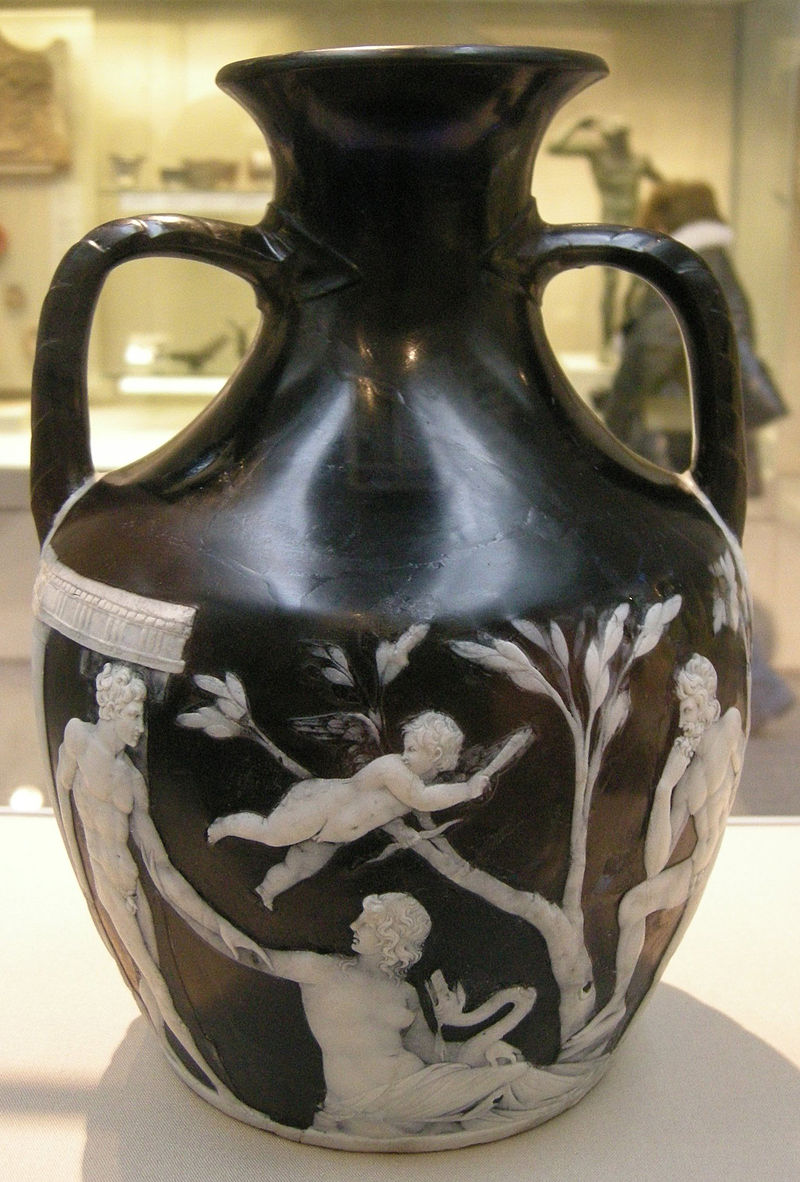
"On the floor was a bronze stand in which sat a miniature amphora, no larger than a jug, but made of dark blue glass rather than the normal pottery, and with figures around it picked out in white. It seemed to tell a story of love and marriage: a young man admiring a reclining woman beneath the shade of a tree; a flying cupid; a woman with a snake. I picked up the amphora. Filled with wine, it was heavy for its size."
He pours himself a cup, and is as struck by the quality of the wine as by that of the vessel containing it.
The amphora is a real object. We know it as the "Portland Vase," and it can be seen in the British Museum. It has a fascinating biography, insofar as we can reconstruct it.
The Portland Vase. Photo: Sailko (licensed under GNU).
As an object, it is completely unique. Amphorae - vessels for the storage and transport of wine, are almost invariably made of pottery. There are a handful of glass examples, and none quite like this. Its manufacture involved the blue glass vessel first being blown, then, after cooling, immersed in white glass. Finally, most of the white glass was chipped away, leaving only the figures remaining. This is a technique more commonly used for making cameos from stone, and was rarely attempted on glass. This final stage is most probably the work of a Greek cameo master, Dioskourides, who was active in the late 1st Century BC.
Although no record exists of the vessel having been commissioned, there is really only one person at the time who could have caused such an object to be made: the Emperor Augustus. The flying cupid with a torch clearly suggests a wedding, perhaps that of Augustus's daughter, Julia Major, with Marcellus in 25 BC. Scholars have debated the significance of the other figures for centuries. In the first picture above, does the woman beneath the Cupid represent Ariadne, Cleopatra or Thetis? Is the snake an asp, or does it represent Apollo? Some think the male figure to her left is Bacchus, others that it is Mark Antony. Is the reclining woman on the second photograph Ariadne, or Augustus's sister, Octavia Minor (abandoned by her husband, Mark Antony, just as Ariadne had been abandoned by Theseus)? Perhaps these ambiguities are intentional?
Having been used, in all likelihood, to serve wine at an imperial wedding, the vessel is likely to have remained in the palace on Rome's Palatine Hill (my justification for placing it in Cogidubnus's bed-chamber in 43/44 AD). At some stage, it was either deliberately modified, or perhaps repaired, following an accidental breakage, giving it the flat base that we see today.
The circular disc that formed the base of the vase, depicting Priam or Paris. It is unclear whether this was added in antiquity, or subsequent to its discovery. Photo: Carole Raddato (licensed under CCA).
In 235 AD it was buried in the tomb of the Emperor, Alexander Severus, where it remained, intact, until its discovery during excavations in 1582. In 1601 it was in the collection of Cardinal Francesco Maria del Monte. It later passed into the hands of the Barberini family: a French scholar, Nicholas Claude Fabri de Peiresc saw it there, and wrote to his friend, Peter-Paul Rubens, suggesting that he should paint it (he never did).
In 1778, the vase was acquired by Sir William Hamilton, the British Ambassador at Naples. Hamilton frequently sold pieces on to young men travelling through Italy on the Grand Tour, but few Grand Tourists had pockets deep enough to allow them to acquire such a work as this. Hamilton eventually sold it to Margaret Cavendish-Bentinck, the Dowager Duchess of Devonshire, who passed it to her son, the Third Duke.
It was the Third Duke of Devonshire who lent the vase to the pottery magnate, Josiah Wedgwood, who kept in in his studio for four years, trying to perfect a ceramic reproduction. Wedgwood's limited edition of ceramic Portland vases appeared in 1790, and was the inspiration for the blue and white "Jasperware" range of Wedgwood ceramics which continues to be produced today.
Ceramic copy of the Portland Vase produced by Josiah Wedgwood in 1790. Cleveland Museum of Art, Ohio. Photo: Daderot (image is in the Public Domain).
The Duke was ultimately prevailed upon to place the vase on indefinite loan to the British Museum "for safekeeping," but this proved to be a big mistake. In 1845, a drunken student knocked it off its pedestal, shattering it. The staff of the British Museum repaired it as best they could, but an embarrassing tray remained of pieces that they were unable to fit back in.
In 1945, the British Museum purchased the vase from the 7th Duke of Portland. It was taken apart by the museum's conservators, who managed to fit some of the "spare" pieces back in, but still the tray remained. Not until 1989 was the modern reconstruction completed, but I am assured that there are no "spare" pieces remaining.
Mark Patton's novels, Undreamed Shores, An Accidental King and Omphalos are published by Crooked Cat Publications, and can be purchased from Amazon.
Wednesday, 26 August 2015
A History of the World in 50 Novels. 30 - "Longbourn," by Jo Baker
The 18th and 19th Centuries in the British Isles were marked by profound social and economic change. With increasing global trade, there were certainly fortunes to be made, but not without taking risks, and there was no effective welfare state to protect those who made the wrong choices, or who were simply unlucky. Developments in agriculture (crop rotation, the enclosure of common land, the selective breeding of livestock) meant that there were fewer livings to be had on the land: families that had tilled the soil, or herded sheep, for more than a thousand years found themselves without a livelihood. Thousands flocked to the industrial towns of Northern England and Scotland to join the growing ranks of factory workers. As the rich became richer and the poor became poorer, however, a new opportunity arose: domestic service.
Rich people had always had servants, of course, but there were now more rich people in the British Isles than ever before, and, where the rich led, the middle classes followed. Great aristocratic houses such as Chatsworth and Longleat employed armies of male and female servants, but even people of "the middling sort," "gentle-folk" rather than aristocrats or industrialists, might now afford to keep a butler and a housekeeper, a couple of maids and a manservant. There were more subtle changes, as well. It was no longer the butler or steward who commanded the servants of a household, but rather the housekeeper; and she reported not to the man, but to the lady of the house.
"As with the commander of an army, or the leader of any enterprise," wrote Isabella Beeton, in her Book of Household Management, "so it is with the mistress of a house. Her spirit will be seen through the whole establishment; and just in proportion as she performs her duties intelligently and thoroughly, so will her domestics follow her path."
Housemaids at Byfield, Northamptonshire, late 19th or early 20th Century. Photo: Historic England, BB98106062 (reproduced with permission).
The relationships between families and their servants involved a combination of intimacy and social distance that has few parallels in the modern world, but such relationships dominated people's lives for generations. Between 1750 and 1920, all the women of my mother's family were in service until they left to marry tradesmen (carpenters, blacksmiths, tailors, later railwaymen).
We catch glimpses of these relationships in the novels of the time, but only fleetingly, since the servants are always in the background. In her novel, Longbourn, Jo Baker re-imagines Jane Austen's Pride and Prejudice from the servants' point of view.
The Longbourn household, home to Mr & Mrs Bennett and their five daughters, had only five servants (Pemberley would have been a very different novel): Mr & Mrs Hill, the butler and housekeeper; two maids, Sarah and Polly; and a manservant, James.
Luckington Court, Wiltshire, featured as Longbourn in Andrew Davies's 1995 television adaptation of Pride and Prejudice. Photo: Paul Ashwin (licensed under CCA).
The much grander Lyme Park, Cheshire, featured in the same adaptation as Pemberley, home to Mr Darcy. Photo: Mike Colvin (licensed under CCA).
Jo Baker remains essentially true to Austen's original story, and adopts a similar narrative voice, whilst introducing several twists of her own, but gives us a wholly different perspective.
"There could be no wearing of clothes without their laundering, just as surely as there could be no going without clothes, not in Hertfordshire, anyway, and not in September. Washday could not be avoided, but the weekly purification of the household's linen was, nonetheless, a dismal prospect for Sarah. The air was sharp at four thirty in the morning, when she started work. The iron pump-handle was cold, and even with her mitts on, her chilblains flared as she heaved the water up from the underground dark and into her waiting pail. A long day to be got through, and this just the very start of it."
"Mr Collins must, of course, be made to see how entirely necessary the current servantry were to the future enjoyment of his inheritance: he could, if he chose to, dismiss them all with a snap of the fingers once Mr Bennett was dead, and this secure little arrangement would be peeled into its separate parts and flung to the four winds. Poor Mr Hill would die of it, that much was certain. Little Polly would fall foul of something or someone, being far too young and far too daft to fend for herself, and Sarah was simply too trusting to be out alone in the world."
Lydia showing her ring to Mrs Hill and the housemaids. C.E. Brock, 1895 (image is in the Public Domain).
"Sarah did not know what she had expected, but clearly she had expected something, or her chest would not feel as hollow and grey as it now did ... 'When you write next to Miss Lydia, miss,' she asked Elizabeth, 'would you mind asking her, if it is not too much trouble, if there is any news of Mr Smith at Brighton?' ... Elizabeth frowned, half shook her head. 'I'm sorry. Of whom?' ... Elizabeth's expression cleared. 'Oh! Smith! You mean the footman! ... You called him Mr Smith, that's why I misunderstood you ... Well then, I shall mention it as you ask ... but I fear her thoughts are so occupied with officers that it will be unlikely she would spare much notice for a footman.'"
Scene from Joe Wright's 2005 film adaptation of Pride and Prejudice, in which the town of Stamford, Lincolnshire, featured as Meryton, the Hertfordshire town closest to Longbourn. Photo: Nat Bocking (licensed under CCA).
This goes well beyond what is sometimes thought of as "fan-fiction" - taken together, Austen's novel and Baker's give a fuller picture of their time and place than any single novel I can think of.
Mark Patton's novels, Undreamed Shores, An Accidental King and Omphalos, are published by Crooked Cat Publications, and can be purchased from Amazon.
Wednesday, 19 August 2015
The Grand Tour: Classical Antiquity and the British Class System
Between 1660 and 1789, hundreds of young British men, and a much smaller number of young British women, undertook a rite of passage, a secular pilgrimage of sorts, travelling through Europe to see the sights of Paris, Geneva, Venice and Rome.
Overseas travel of any sort was, of course, a possibility only for those with a certain level of financial means, but, whilst the wealthiest aristocrats traveled in private carriages with substantial retinues of servants, commissioning portraits from fashionable artists such as Pompeo Batoni, and buying up large collections of classical sculpture to ship home, it was possible for individuals of more modest means to travel with one or two companions, seeing the same sights, and returning, perhaps, with some volumes of Piranesi engravings, together with one's own book of sketches.
Although this "Grand Tour" shared many of the features of a pilgrimage (it followed an established route, with opportunities to meet fellow travelers along the way, and involved shared experiences at specific places), its aims were educational rather than religious. The education was as much social as intellectual: the idea of a "British Empire" was still in the process of being defined, but it was looking (at least, to the British upper classes) increasingly like a mirror image of the Roman Empire.
Ancient Rome had had three classes of free men: Patricians, who owned land and governed the empire; Equestrians, who served as officers in the army; and Plebians, who made their living by trade. Upward mobility was possible (even for a slave, who might hope to be freed, and whose free-born sons then had the status of citizens), but it involved a great deal of hard work: through commerce and wealth accumulation, if you were a Plebian aspiring to be an Equestrian; and through military service and political machinations if you were an Equestrian aspiring to be a patrician. The message of the Grand Tour was that advancement within modern Britain operated in much the same way.
The Temple family of Stowe, in Buckinghamshire, are a good example of this neo-Roman aspirational ideal. They had made their wealth, in the 16th Century, from the wool-trade. Thomas Temple purchased a knighthood from James I (a king who, on succeeding Elizabeth I, entered London in a Roman-style Triumph) in 1603 and, eight years later, upgraded it to a baronetcy (in effect, a knighthood that can be inherited). His successors took the Parliamentary side in the English Civil War, fighting with distinction in the army of Oliver Cromwell, but they quickly adapted to the new environment of the Restoration (knowing perfectly well the example of the Roman senators who transferred their allegiance from the Republic to the rule of Augustus Caesar). The Fourth Baronet was raised to the peerage in 1714.
Rome itself was the primary destination of the Grand Tour. All grand tourists had an itinerary that included the Colosseum, the temples of the Forum Romanum and the Pantheon, returning home with sketches of these monuments, the architectural features of which might subsequently be used as models for their own country seats. Sir William Hamilton (he who would later be cuckolded by Horatio, Lord Nelson), as British Ambassador to the Kingdom of Naples from 1764 to 1800, was a great promoter of the Grand Tour, enticing the tourists to extend their journey southwards, to the excavations at Pompeii and Herculaneum, and to Paestum, where Greek, as well as Roman, antiquities could be seen.
The English Banker, Henry Hoare (1705-1785) seems to have made his Grand Tour, like Goethe, when he was in his thirties, setting out in 1738, following the death of his mother. He was, by this stage, already married, with three children, so it is possible that they traveled as a family.
We do not know Hoare's precise itinerary, but he seems to have been away for almost two years. On his return, inspired by the landscapes and monuments that he had seen, by artworks that he had viewed in continental collections, and by paintings that he himself owned, he set about transforming the garden that he had inherited from his parents at Stourhead, Wiltshire, into an allegory of classical antiquity, with a series of temples constructed by the builder, Henry Flitcroft. This constructed landscape served to demonstrate not only his wealth, but also his learning, taste, and refinement.
The gardens created by Hoare at Stourhead, as well as providing a lasting (if idealised) memory of his Grand Tour, are Picturesque: that is to say that they are carefully designed in such a way that specific viewpoints, such as those illustrated above, resemble the compositions of paintings, and specifically the works of artists fashionable during Hoare's lifetime: notably Claude Lorrain, Poussin, and Gaspard-Dughet. One painting that certainly influenced Hoare in the construction of his garden was Claude's "Landscape with Aeneas at Delos, which he himself owned.
There was even a moral dimension to the Grand Tour, the artworks that inspired it, and the landscapes that were constructed to evoke it. Just as the character of Aeneas, in Vergil's Aeneid, is defined by his epic journey from the destruction of Troy to the lands where Rome would ultimately be built, so the character of a man such as Henry Hoare was defined by his (admittedly more leisured) progress through the landscape of ruined Rome; and just as Aeneas's greatness was something to be passed on to future generations (the Emperor Augustus claimed descent from him), so a landscape such as Stourhead, with its many layers of meaning, would become part of the inheritance of Hoare's heirs and successors.
The French Revolution, and, later, the Napoleonic Wars, made the Grand Tour more difficult, more dangerous and much more expensive. Lord Byron did make a Grand Tour of sorts, between 1809 and 1811, but few had his resources, or his family's naval connections, which he called upon more than once to assist him in his travels. Athens, rather than Rome, was the cultural high-point of his journey, from which he did not return alive, perhaps the clearest of indications that the era of the Grand Tour, as experienced by men such as Henry Hoare, had come to an end.
Mark Patton is a published author of historical fiction and non-fiction, whose books can be purchased from Amazon.
Overseas travel of any sort was, of course, a possibility only for those with a certain level of financial means, but, whilst the wealthiest aristocrats traveled in private carriages with substantial retinues of servants, commissioning portraits from fashionable artists such as Pompeo Batoni, and buying up large collections of classical sculpture to ship home, it was possible for individuals of more modest means to travel with one or two companions, seeing the same sights, and returning, perhaps, with some volumes of Piranesi engravings, together with one's own book of sketches.
![]() |
| Anthony Ashley-Cooper, 5th Earl of Shaftesbury, as depicted by Pompeo Batoni (image is in the Public Domain) |
Although this "Grand Tour" shared many of the features of a pilgrimage (it followed an established route, with opportunities to meet fellow travelers along the way, and involved shared experiences at specific places), its aims were educational rather than religious. The education was as much social as intellectual: the idea of a "British Empire" was still in the process of being defined, but it was looking (at least, to the British upper classes) increasingly like a mirror image of the Roman Empire.
Ancient Rome had had three classes of free men: Patricians, who owned land and governed the empire; Equestrians, who served as officers in the army; and Plebians, who made their living by trade. Upward mobility was possible (even for a slave, who might hope to be freed, and whose free-born sons then had the status of citizens), but it involved a great deal of hard work: through commerce and wealth accumulation, if you were a Plebian aspiring to be an Equestrian; and through military service and political machinations if you were an Equestrian aspiring to be a patrician. The message of the Grand Tour was that advancement within modern Britain operated in much the same way.
The Temple family of Stowe, in Buckinghamshire, are a good example of this neo-Roman aspirational ideal. They had made their wealth, in the 16th Century, from the wool-trade. Thomas Temple purchased a knighthood from James I (a king who, on succeeding Elizabeth I, entered London in a Roman-style Triumph) in 1603 and, eight years later, upgraded it to a baronetcy (in effect, a knighthood that can be inherited). His successors took the Parliamentary side in the English Civil War, fighting with distinction in the army of Oliver Cromwell, but they quickly adapted to the new environment of the Restoration (knowing perfectly well the example of the Roman senators who transferred their allegiance from the Republic to the rule of Augustus Caesar). The Fourth Baronet was raised to the peerage in 1714.
Rome itself was the primary destination of the Grand Tour. All grand tourists had an itinerary that included the Colosseum, the temples of the Forum Romanum and the Pantheon, returning home with sketches of these monuments, the architectural features of which might subsequently be used as models for their own country seats. Sir William Hamilton (he who would later be cuckolded by Horatio, Lord Nelson), as British Ambassador to the Kingdom of Naples from 1764 to 1800, was a great promoter of the Grand Tour, enticing the tourists to extend their journey southwards, to the excavations at Pompeii and Herculaneum, and to Paestum, where Greek, as well as Roman, antiquities could be seen.
![]() |
| The Temple of Saturn, in the Forum Romanum, as depicted by Giovanni Battista Piranesi (image is in the Public Domain). |
![]() |
| The Temple of Athena at Paestum. Photo: Michael Johanning (licensed under GNU). |
The English Banker, Henry Hoare (1705-1785) seems to have made his Grand Tour, like Goethe, when he was in his thirties, setting out in 1738, following the death of his mother. He was, by this stage, already married, with three children, so it is possible that they traveled as a family.
![]() |
| Henry Hoare, by William Hoare of Bath, The Getty Collection, 263439 (Photo: Getty Research Institute, Open Content Programme). |
We do not know Hoare's precise itinerary, but he seems to have been away for almost two years. On his return, inspired by the landscapes and monuments that he had seen, by artworks that he had viewed in continental collections, and by paintings that he himself owned, he set about transforming the garden that he had inherited from his parents at Stourhead, Wiltshire, into an allegory of classical antiquity, with a series of temples constructed by the builder, Henry Flitcroft. This constructed landscape served to demonstrate not only his wealth, but also his learning, taste, and refinement.
![]() |
| The Temple of Apollo at Stourhead. Photo: Hans Bernhard (Schnobby), licensed under CCA (GFDL-CC-BY-SA). |
![]() |
| The Pantheon at Stourhead. Photo: Luke Gordon (licensed under CCA). |
![]() |
| The view from the grotto at Stourhead. Grottoes are artificial caves, where the presence of mythical beings, such as nymphs, might be imagined. Photo: Neil Kennedy (licensed under CCA). |
The gardens created by Hoare at Stourhead, as well as providing a lasting (if idealised) memory of his Grand Tour, are Picturesque: that is to say that they are carefully designed in such a way that specific viewpoints, such as those illustrated above, resemble the compositions of paintings, and specifically the works of artists fashionable during Hoare's lifetime: notably Claude Lorrain, Poussin, and Gaspard-Dughet. One painting that certainly influenced Hoare in the construction of his garden was Claude's "Landscape with Aeneas at Delos, which he himself owned.
![]() |
| "Landscape with Aeneas at Delos," by Claude Lorrain, c 1672, National Gallery NG1018 (image is in the Public Domain). |
![]() |
| "Landscape with Orpheus and Eurydice," by Nicolas Poussin, The Louvre, 7307 (image is in the Public Domain). |
![]() |
| Landscape with Abraham and Isaac, by Gaspard-Dughet, c 1665, National Gallery, NG31 (image is in the Public Domain). |
There was even a moral dimension to the Grand Tour, the artworks that inspired it, and the landscapes that were constructed to evoke it. Just as the character of Aeneas, in Vergil's Aeneid, is defined by his epic journey from the destruction of Troy to the lands where Rome would ultimately be built, so the character of a man such as Henry Hoare was defined by his (admittedly more leisured) progress through the landscape of ruined Rome; and just as Aeneas's greatness was something to be passed on to future generations (the Emperor Augustus claimed descent from him), so a landscape such as Stourhead, with its many layers of meaning, would become part of the inheritance of Hoare's heirs and successors.
The French Revolution, and, later, the Napoleonic Wars, made the Grand Tour more difficult, more dangerous and much more expensive. Lord Byron did make a Grand Tour of sorts, between 1809 and 1811, but few had his resources, or his family's naval connections, which he called upon more than once to assist him in his travels. Athens, rather than Rome, was the cultural high-point of his journey, from which he did not return alive, perhaps the clearest of indications that the era of the Grand Tour, as experienced by men such as Henry Hoare, had come to an end.
Mark Patton is a published author of historical fiction and non-fiction, whose books can be purchased from Amazon.
Subscribe to:
Posts (Atom)