Showing posts with label 17th Century. Show all posts

Sunday, 9 January 2022

Thomas Lambe, Soap-Boiler and Baptist Preacher: A Religious and Political Radical in 17th Century London

This blog-post is a summary of research that I carried out for the Worshipful Company of Tallow Chandlers, during the course of 2020 and 2021, and presented to the company in November, 2021. Thomas Lambe, a freeman of the company in the early decades of the 17th Century, was a soap-boiler (a producer of soap from rendered animal fat - an activity forming part of the craft and mystery of tallow-chandlery as defined at the time), who was also a controversial Baptist preacher, and a leading member of the "Levellers," a radical political movement agitating for universal manhood suffrage (the vote for every adult male), fixed-term parliaments, the abolition of capital punishment for theft, and the abolition of imprisonment for debt.  
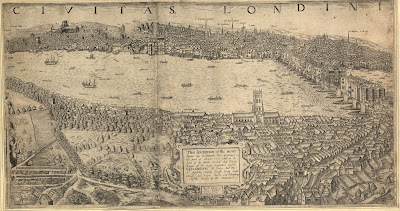

London in the late 16th Century.


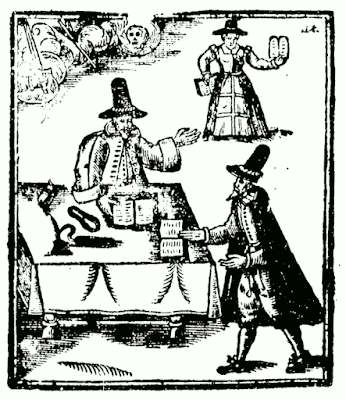
Illustration from The Declaration and Standard of the Levellers of England, 1649.


Several of the most widely read recent books on the "Leveller" movement (a label rejected by most of its supporters, on the grounds that they did not support the "levelling of mens' estates," except on a purely voluntary basis), including John Rees's The Leveller Revolution, state that Lambe was one of two tallow chandlers involved in its leadership, the other being Thomas Prince. I did not, however, find Prince's name in the membership records of the company, and nor could I find any particular reason why Prince, who made his living as a cheese-monger, should have been a member of it. Prince is a fascinating historical figure in his own right, but my research focused on Thomas Lambe (to confuse matters further, there seem to have been two Baptist preachers named Thomas Lambe active in London at the same time; one described as a soap-boiler, the other as a merchant; and I am writing only about the former).

Thomas Lambe seems to have been born at Colchester, where he may also have served an apprenticeship as a tallow chandler and soap-boiler. I was unable to trace a baptismal record for him, but he did marry Dorcas Prentice there in 1619. Whilst living in Colchester, the couple fell foul of the authorities several times: they were excommunicated in 1636, for failing to attend (Anglican) worship, and for refusing to have one of their children baptised; the following year, still in Colchester, Thomas was arrested for "soap-boiling on the Sabbath." 

Thomas Lambe seems to have taken up residence in London by 1624 (the date at which his name first appears in the membership records of the Tallow Chandlers). The fact that his name appears, in the 1620s and 1630s, both in London and in Colchester, might suggest that he and Dorcas had two homes, the one in Colchester very possibly shared with one or more of their parents. Thomas was imprisoned in the Fleet Gaol in 1640, for unlicensed preaching in Whitechapel (provoking a riot when constables attempted to break up the meeting); but, by 1641, had established a Baptist congregation in Bell Alley (off Coleman Street, near the Guildhall); by this time, he seems to have been permanently resident in London. He undertook several preaching tours of England, visiting Guildford, Portsmouth, & Devizes; and baptising people in the Severn and the Colne (he seemingly had more sense than to do so in the filthy waters of the Thames at London).
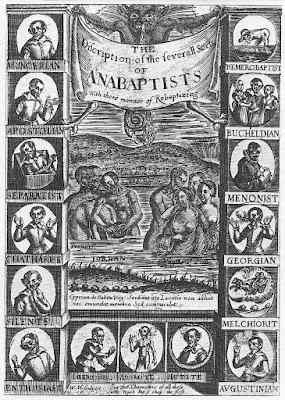

"The Dippers Dipp'd," from an anti-Baptist pamphlet by Daniel Featley (1649), portraying Baptists as schismatics.

Lambe's congregation in Bell Alley soon gained a reputation for religious radicalism. The Presbytereian, Thomas Edwards, complained about the role of "mechanicks" (artisans and working people, without formal training in theology) in preaching: Lambe even encouraged women, including a lace-maker, Mrs Attaway, to preach in his church, someting that would not have been permitted in more conventionally "Puritan" congregations (few people in 17th Century England considered themselves to be "Puritans" - the term was almost always used in a derogatory sense, to refer to people who saw themselves as Presbyterians, "Independents" - in modern terms Congregationalists, Baptists, and Quakers). Edwards (whose agenda was to extinguish all forms of "Puritanism" other than his own) raised further objections to Lambe's congregation:

"Many use to resort to this church and meeting, the house and yards full, especially young youths and wenches flock thither ... in the latter end of the Lord's Day, many persons, some from the separate churches [Independent, Quaker], others from our churches [formerly Anglican, converted to Presbyterian worship], will go to this Lambe's church for novelty, because of the disputes and wranglings that will be there upon questions ... several parties in one room, some speaking in one part, some in another ... "
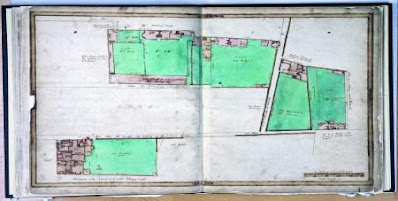

Bell Alley, 17th Century plan.


Among the questions thus debated by Lambe's congregants was the suggestion, heretical to men such as Edwards, of "universal reconciliation," according to which everyone (or, at the very least, all Christian believers) would ultimately be saved, through the boundless love and grace of Jesus Christ.

Lambe was a close associate of Richard Overton, also a Baptist (and thus probably a member of Lambe's congregation), and a "Leveller," who ran an undreground printing operation from Bell Alley.

The Wren Library at Trinity College, Cambridge, holds one of very few surviving copies of Lambe's Treatise of Particular Predestination, printed by Overton, which argues that:

" ... the spirit of the Gospel, which holds forth Christ's giving himself, a ransom for all men [1 Tim, 6], a propitiation for the sinnes of the whole world [1 John, 2,2], and that he tasted death for every man [Heb.2.9], which is such a glorious truth, as without which first the Gospel of God's free grace cannot be preached to all men."

He goes on, in this pamphlet, to argue against the Calvinist notion (accepted by most Presbyterians and Independents, as well as by many less radical Baptists) that only some people have been chosen by God for salvation.   

In 1641, as the battle lines were being drawn up between Charles I and Parliament, "Puritans" within the City of London (already, probably, in a small majority) staged an effective coup, replacing all, or nearly all, of the Anglicans and Royalists on the Common Council with Presbyterians and Independents whose loyalty was to Parliament. Isaac Pennington became the first in a line of "Puritan" Lord Mayors. The new administration quickly formed a "Committee of Safety," and took control of the "London Trained Bands." This militia, which had served for many years as a police and civil defence force, and as an informal fire brigade, would become the backbone of the Parliamentary Infantry, under the command of Philip Skippon, a Presbyterian who had served as a mercenary, on the Protestant side, in the Thirty Years War in Germany. If Thomas Lambe had ever served in the Trained Bands, it would have been in the 1620s, when he was first living in London. Although we do not know when he was born, his date of marriage suggests that, by the 1640s, he would probably have been considered too old for front-line military service.

Whilst he probably played no active role in the civil wars themselves, he was certainly engaged in the attempt to define the new society that it was hoped would emerge from them. Together with his friends, the printer, Richard Overton; the cheese-monger, Thomas Prince; and other prominent Londoners, including John Lilburne; he was a member of the "Levellers," a movement which some have seen as England's first political party. Initially, in the 1640s, it was a loose alliance of men, who met to discuss political topics, in taverns including The Windmill and The Whalebone, both in Lothbury. One such discussion group was the "Robin Hood Club," and the association with the legendary outlaw was more than accidental. Later, members of these various discussion groups took to wearing a sea-green ribbon, as a means of identifying themselves.

A "Leveller" manifesto of 1649, signed by Lilburne, Prince, and Overton, sets out what they thought to be at stake: " ... an opportunity which, these 600 years, has been desired, but could never be obtained, of making this a truly happy and wholly free nation ...


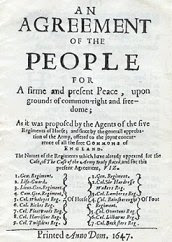
A "Leveller" manifesto, 1647.


The "Levellers" seem to have been a genuinely grass-roots movement, led by artisans and "mechanicks," rather than by intellectuals. Leaving aside John Milton's Areopagitica (1644), which many of these men might indeed have read, but the title of which probably meant little to them, radical tracts of the time, including "Leveller" pamphlets, do not draw their inspirations from the examples of either the Athenian Democracy, or the Roman Republic, nor do they make reference to the constitutional example of the Polish-Lithuanian Commonwealth. Instead, they draw on folk traditions of Anglo-Saxon resistance to Norman rule (seeing Charles Stuart as the successor of William the Conqueror), including the mythical example of Robin Hood, and the supposedly "consensual" or constitutional basis of rule by the Anglo-Saxon Kings, including Alfred the Great.  

Here, for example, is Gerard Winstanley, writing in 1649 (and criticising not Charles Stuart, who by that stage was dead, but the "Puritan" establishment of the Commonwealth itself):

"O what mighty delusion, do you, who are the powers of England, live in! That while you pretend to throw down the Norman yoke, and Babylonish power, and have promised to make the groaning people of England a Free People; yet you still lift up that Norman yoke, and slavish tyranny, and holds the People as much in bondage, as the Bastard Conquerour himself, and his Councel of War." 

The "Leveller" manifestoes of 1648-49 were radical indeed, including commitments to "manhood suffrage" (the right of every man, possibly excluding servants, to vote); fixed term (biennial) parliaments; "absolute" freedom of religion (it is a little unclear whether this was intended to include Roman Catholics or Jews); the abolition of capital punishment for theft; and the abolition of imprisonment for debt. For so long as these were simply matters for discussion in London taverns, Presbyterians and "Silken" (presumably well-heeled and socially conservative) Independents paid little attention to them, but, by 1647, "Leveller" opinions were gaining currency within the ranks of the New Model Army, which senior commanders, including Oliver Cromwell, took far more seriously.

In the Putney Debates, chaired by Cromwell, and prompted by arrears in pay to soldiers, the "Leveller," Colonel Thomas Rainsborough, argued that:

"I think that the poorest hee that is in England hath a life to live, as the greatest hee; and therefore, truly Sir, I think itt clear, that every Man that is to live under a Government ought first by his own Consent to put himself under that Government; and I do think that the poorest man in England is not at all bound in a strict sense to that Government that he hath not had a voice to put Himself under."

To which Henry Ireton (Cromwell's son-in-law, and a representative of the Army high command) responded:

" ... no man hath a right to an interest or share in the disposing of the affairs of the kingdom ... that hath not a permanent fixed interest in this kingdom."

Ireton's point was that citizenship, including the right to vote, was only for property owners, a principle that held fast in English law until 1918 (when, incidentally, property qualifications were introducedd for women, just as they were abolished for men). The army grandees listend politely to the arguments in 1647, but did not toleraate them after the talks broke up. In April, 1649, weeks after the execution of Charles I, an NCO and "Leveller," Robert Lockyer, faced a firing squad in the churchyard of Saint Paul's Cathedral, having been charged with mutiny against his officers. At his funeral, a procession of 3000 people included Parliamentary soldiers wearing the sea-green ribbons of the "Levellers." London "Levellers," including Thomas Lambe, are likely to have been in the crowd, and may have given speeches, although none have not been preserved.

The hopes of London radicals, such as Lambe, Prince, Overton, and Lilburne, were comprehensively dashed when Cromwell took power as Lord Protector in 1653. Thomas Lambe's conventicle had moved, by this stage, from Bell Alley to Smithfield, but we hear nothing of him beyond this date. We do not know the date of his death, or of Dorcas's, and, if they were buried in London, the records are likely to have been destroyed in the Great Fire of 1666.

The legacy of the "Levellers" proved to be far longer lived than the movement itself: many of their objectives, including manhood suffrage, were taken up by the Chartists, in the 1840s, although they, like the "Levellers" before them, failed to achieve these objectives in their lifetimes. Significantly, Chartist rhetoric drew explicitly on the example of the "Levellers," and of the 14th Century "Peasants' Revolt," more so than on the examples sof democracy or republicanism in the ancient world that had been favoured by some of the French Revolutionaries of the late 18th Century; or the more explicitly socialist themes that marked out 1848 as a "Year of Revolutions" in France, Germany, and Italy.

We do not, in any direct sense, have the "Levellers" to thank for our current parliamentary democracy, still less for our constitutional monarchy, which most of them would probably have opposed; but the 1640s saw the first moment in our history in which matters of constitutional government, as well as those of religious faith, were freely and openly discussed, not only in the corridors of power, but in taverns, and on the streets, and by "mechanicks," as well as by intellectuals, and by university-educated clergy. 

Many of the ideas that first arose in this moment (manhood suffrage, religious tolerance, the abolition of imprisonment for debt) have been quietly incorporated into our law in the centuries that followed, whilst others (including biennial parliaments) have been dropped for good reasons. The debates themselves, however, continue, and it is in this broader sense, perhaps, that we are, all of us, the sons and daughters of that moment.

 Mark Patton is a published author of historical fiction and non-fiction, whose books can be purchased from amazon.   

Tuesday, 3 September 2019

The Streets of Old Westminster: "Strange Woods:" - St James's Park & Buckingham Palace

A visitor to London, having walked along the Victoria Embankment, can walk along the northern side of Parliament Square, and cut through Great George Street into St James's Park. One of the many things that I love about living in London, in comparison with other great World cities, is the expanses of green space and mature trees to be found even at the heart of the metropolis. St James's is just one of the eight Royal Parks of London (though there are many other green spaces), and covers an area of almost 57 acres, with a stretch of fresh water running down its centre.


St James's Park, looking east towards Whitehall. Photo: Colin, licensed under CCA.


Originally an area of marshland, on either side of the River Tyburn (a left-bank tributary of the Thames, now almost completely invisible), the land was purchased by Henry VIII, and drained during the reign of James I. In James's time, it housed a menagerie, through which camel, crocodiles, and an elephant roamed. "Birdcage Walk," which runs along the southern edge of the park, is named for the aviaries that once lined its route. It was through St Jame's Park that his son, Charles I, too his last walk, from St James's Palace to his execution at Whitehall, guarded by Oliver Cromwell's soldiers.

When Charles II came to the throne in 1660, he had the park redesigned by the French landscape architect, Andre Mollet (a contemporary of the more famous, and more expensive, Andre Le Notre), with a canal at its centre. Charles was known to promenade his mistresses here, and it soon became the custom that favoured gentlemen of the court were given keys  to the park, so that they might use it for similar assignations. It was the Russian Ambassador to the court of Charles II who first presented pelicans to live in the park, and there are still pelicans there today, although they may not be descended from the original birds.


Mollet's original drawing of the layout of St James's Park (Image is in the Public Domain).


St James's Park in c 1680, reproduced by F.T. Smith in 1804 (Image is in the Public Domain).


The courtier, libertine, and poet, John Wilmot, the Second Earl of Rochester, summed up the park's Seventeenth Century reputation in his poem, "A Ramble in St James's Park:"

"Much wine had passed, with grave discourse
Of who f****s who, and who does worse
(Such as you usually do hear
from those that diet at The Bear),
When I, who still take care to see
Drunkenness relieved by lechery,
Went out into St James's Park
To cool my head and fire my heart.
But though St James has th'honour on't,
Tis consecrate to p***k and c**t.
There, by a most incestuous birth,
Strange woods spring from the teeming earth ...
...Each imitative branch does twine
In some loved fold of Aretine,
And nightly, now, beneath their shade
Are buggeries, rapes, and incests made ..."


John Wilmot, 2nd Earl of Rochester, by Peter Lely, c 1677. Photo: Victoria & Albert Museum 491-1882 (Image is in the Public Domain).


In the Eighteenth Century, the eastern end of the canal was filled in to make way for Horse Guards' Parade; and the entire park was redesigned by the architect, John Nash, in the Nineteenth - the straight canal became a more sinuous "lake," and an ornamental bridge was added. The bridge was in the Oriental style popular at the time, and had a pagoda at its centre, which burned down when a fireworks display, to celebrate the defeat of Napoleon, went catastrophically wrong. 


St James's Park, by Joseph Nickolls, 1771-72. Photo: Royal Collections Trust (Image is in the Public Domain).

The Pagoda and Bridge in Saint James's Park (Image is in the Public Domain).

St James's Park in 1833, by W. Schmollinger (Image is in the Public Domain).


The Ornithological Society of London endowed the park with a much wider assortment of exotic wildfowl, as can be seen today, and also built the Birdkeeper's Cottage, which still stands.


The Birdkeeper's Cottage. Photo: Peter K. Burton (licensed under CCA).


At the western end of the park, a series of opulent Seventeenth Century residences were replaced, in 1703, by a single estate, known as Buckingham House. This was bought by George III, in 1761, as a retreat for his Queen, Charlotte. When George IV ascended the throne, he employed John Nash to convert it into a palace worthy of a King. Nash's works included the Marble Arch, which was moved to its present location (where the Tyburn gallows had once stood) in 1847, to make way for a new East Wing to the Palace, which is the main facade presented to the public today.


Buckingham House in 1710 (Image is in the Public Domain).

Buckingham Palace in 1837, by John Woods (Image is in the Public Domain).


Buckingham Palace from St James's Park. Photo: Pointillist (Image is in the Public Domain).

Mark Patton is a published author of historical fiction and non-fiction, whose books may be purchased from Amazon.

Tuesday, 11 June 2019

The Streets of Old Westminster: Lundenwic and The Strand

A visitor to London, exploring the City of Westminster, and having walked along Whitehall, can turn to the east and walk along The Strand, passing Charing Cross Railway Station on the right. This was the main street of early Saxon Lundenwic, the trading port that replaced the Roman city of Londinium, which had been abandoned following the collapse of Roman administration in Britain in the early Fifth Century AD. Whereas Roman ships, sailing to and from the Mediterranean, tied up at stone wharves in the old city, the very different vessels that plied the "Whale Roads" of the early Middle Ages, connecting Lundenwic to the markets of the North Sea and the Baltic, were beached on strands. "The Strand" was, literally, the strand, in the sense of a beach, before the Thames was embanked in the Nineteenth Century. Lundenwic, a settlement of wooden buildings, extended from Saint Martin-in- the-Fields in the west to Saint Clement Danes in the east: traces of it have been found in archaeological excavations over the past hundred years, and can be seen in the Museum of London.


Map of Lundenwic, Museum of London (Image is in the Public Domain).


Nothing of Lundenwic (other than the course of The Strand itself) is visible on the ground today. There is, similarly, little to see of most of the opulent great houses that, throughout the Middle Ages and into the Sixteenth and Seventeenth Centuries, lined the road that connected the Royal courts of Westminster and Whitehall to Fleet Street and The City: including the London residences of the Dukes of Lancaster; the Earls of Essex and Arundel; and the Bishops of Durham, Exeter, Carlisle, Chester, Worcester and Bath. The grandest of these palaces was the Savoy, which was owned by John of Gaunt, Duke of Lancaster, until it was destroyed in the "Peasants' Revolt" of 1381: the name, alone, survives as The Savoy Hotel, which remains one of London's most exclusive addresses.


The Strand in 1822, showing Saint Mary-le-Strand and Saint Clement-Danes behind, Museum of London (Image is in the Public Domain).


The Strand in 1593 (the Norden Map). British Library (Image is in the Public Domain).

Arundel House from the north, by Wenceslas Hollar, 1647 (Image is in the Public Domain).

Durham House in 1806, by John Thomas Smith (Image is in the Public Domain).

Plan of the Savoy Palace in 1736, from W.J. Loftie (1878) Memorial of the Savoy (Image is in the Public Domain).


The one palace that can still be visited is Somerset House, originally built by Edward Seymour, first Earl of Hertford, and later Duke of Somerset, in 1549. It was sequestered by the Crown, following Seymour's execution in 1552, and subsequently occupied by Anne of Denmark (the wife of James VI and I); Henrietta Maria (the wife of Charles I); and the Parliamentary General, Thomas Fairfax. In its current, neo-Classical, incarnation, it was designed by Sir William Chambers, with new wings being added in 1831 and 1856.


Somerset House, by Jan Kip, 1722 (Image is in the Public Domain).

The terrace of Somerset House, by Canaletto, 1750 (Image is in the Public Domain).


"Old money" gave way to "new" in the Seventeenth and Eighteenth Centuries, and, by the mid-Nineteenth Century, The Strand was very much the domain of entrepreneurs, whose primary business was popular entertainment. One such was Carlo Gatti, an impoverished Swiss immigrant who came to London in 1847, and sold chestnuts and waffles from street stalls. He went on to introduce the ice cream to British consumers for the first time, selling one-lick portions in wafer shells from a stall in Hungerford Market.


Old Hungerford Market, 1805 (Image is in the Public Domain).

A vendor of ice-cream, 1870s, British Library (Image is in the Public Domain).


The market was badly damage by a fire in 1854, but Gatti was insured. He built a music hall with the proceeds of his pay-out, and sold the site to the South-Eastern Railway Company in 1862 at an enormous profit (Charing Cross Station now stands on this site). He opened a second music hall, "Gatti's in the Road," in 1865; and a third, "Gatti's in the Arches," in 1867. In 1871, he returned to Switzerland, a millionaire.

Katie Lawrence at Gatti's, by Walter Sickert, c 1903 (Image is in the Public Domain).

Poster for Gatti's (Image is in the Public Domain).


Another of these entertainment tycoons was Sir Richard d'Oyly Carte, who leased the Opera Comique, off The Strand, in 1874, and who went on to promote the works of William Gilbert and Sir Arthur Sullivan. Like Gatti, he reinvested his early profits, opening the Savoy Theatre in 1881: with seating for 1300 people, this was the first public building in the World to be lit by electricity. With the profits from The Mikado, in 1889, he opened the Savoy Hotel, on the site of John of Gaunt's old palace, employing the dream-team of Cesar Ritz as Manager, and Auguste Escoffier as Head Chef. D'Oyly Carte had to fire both for lining their pockets at his expense, but they did not remain in disgrace for long, going on to found the Ritz Hotel.


The Savoy Theatre, 1881 (Image is in the Public Domain).


To the east of Charing Cross Station, Villiers Street slopes down towards the Thames (it is named after George Villiers, the first Duke of Buckingham (a favourite of James VI and I, and subsequently an adviser to his son, Charles I). Watergate Walk leads off to the east, and brings us to York Watergate, which gave access to Villiers's palace from the river, the preferred means of transport for the wealthier residents of Seventeenth Century London. 


The York Water Gate (1626). Photo: Mike Peel (www.mikepeel.net), licensed under CCA.

The Adelpi from the River, by Henry Pether, c 1850, Museum of London (Image is in the Public Domain).


Mark Patton is a published author of historical fiction and non-fiction, whose books can be purchased from Amazon.

Sunday, 13 January 2019

The Streets of Old Westminster: Precincts of the Palace of Whitehall

A visitor to London, exploring the City of Westminster, and having explored Parliament Square, can walk northwards, along Whitehall, to Trafalgar Square. Whitehall today is lined, as it has been since the Seventeenth Century, by government buildings (HM Treasury, The Ministry of Defence, The Scottish and Welsh Offices), and by statues of some of the leading figures in British military history. Downing Street, where the Prime Minister of the day resides, leads off from it, as does Scotland Yard, formerly the headquarters of the Metropolitan Police from 1829. Whitehall also forms part of one of the most important ceremonial routes in the life of the nation: Royal coronation, wedding, and funeral processions pass this way (replacing the Medieval and Early Modern processional route from the Tower of London through the City); and it is at the heart of the annual commemoration of British and Commonwealth War dead.


Whitehall in 1953, decorated for the coronation of Queen Elizabeth II. Photo: Ben Brooksbank (licensed under CCA).


Whitehall today, looking south, with the Monument to the Women of World War II; and the Cenotaph in the background. Photo: Tbmurray (licensed under CCA). 


In the Thirteenth Century, the area lay outside the precincts of the Palace of Westminster. Most of the English bishops and archbishops kept palaces in London, allowing them to participate in the life of the Court, including the House of Lords. This was York Place, the London palace of the Archbishops of York. As such, it was occupied by Cardinal Wolsey, but was later seized from him by Henry VIII.


Sketch of the Palace of Whitehall, c 1544, including a water-gate (image is in the Public Domain).


During the reigns of Edward VI, Mary I, and James I, the two palaces (Westminster and Whitehall) functioned, in effect, as a single complex. Henry VIII added a bowling green and tennis court, and James I commissioned Inigo Jones to design what is now "The Banqueting House."


Inigo Jones's plan for a new Palace of Whitehall, c 1638 (image is in the Public Domain).

The "Banqueting House." Photo: ChrisO (licensed under GNU).

The ceiling of the "Banqueting House," painted by Peter Paul Rubens, and commissioned by Charles I as a memorial to his father, James I. Photo: The Wub (licensed under CCA).


In 1606, Shakespeare's Macbeth, with its dark themes of regicide and ensuing chaos, received its first performance in this building, in front of James I and his Queen, Anne of Denmark; yet just forty-three years later, the same building witnessed a true regicide, as their son, Charles I, stepped out from one of its windows onto the scaffold, witnessed by a young Samuel Pepys, who recalled a single Biblical verse: "The memory of the wicked shall rot."


The execution of Charles I, c 1649 (image is in the Public Domain).


Pepys had been taken to witness the execution by his father's cousin, the Republican, Sir Edward Montagu, and, during the Commonwealth era, the Palace of Whitehall was occupied by Montagu's patron, Lord Protector Oliver Cromwell. A few decades on, both Montagu and Pepys were Royal servants, playing key roles in the Navy of Charles II.  Pepys began his career as a Naval administrator living, effectively, as Montagu's servant, in his grace and favour apartment in Axe Yard; and later had his own home and offices nearby. There were bars and restaurants in New Palace Yard, where Pepys wined and dined his business contacts and his mistresses; and a theatre, where he enjoyed plays.


The Palace of Whitehall in 1680 (image is in the Public Domain.


New Palace Yard in 1647, by Wenceslas Hollar (image is in the Public Domain).


The old Palace of Whitehall, by Hendrick Danckaerts, c 1675, with the "Banqueting House" on the left (image is in the Public Domain).


Whitehall was re-modeled as a public street in the Eighteenth Century, and the elements of the former palace were gradually dismantled, leaving only the "Banqueting House" as a reminder of its former glories.


Whitehall in 1740, looking south, by John Maurer: the "Banqueting House" is on the left (image is in the Public Domain). The "Holbein Gate" at the centre was builtin 1532, and demolished in 1759.

The Horse Guards Building was designed by William Kent (better known for the interiors and gardens of stately homes), and built, after his death, between 1750 and 1759. Photo: Alistair Welkin (licensed under CCA). 

The modern layout of Whitehall (Ordnance Survey, image is in the Public Domain).


At the Northern end of Whitehall stood Charing Cross, built between 1291 and 1294 to commemorate the funeral procession of Eleanor of Castille, Edward I's Queen. This was destroyed as an "idolatrous" symbol during the era of Cromwell's Commonwealth (the copy that now stands outside Charing Cross Station in The Strand was built during the Nineteenth Century). An equestrian statue of Charles I was erected, in its place, in 1675, and has stood there ever since.


Charing Cross, from John Rocque's map of 1746 (image is in the Public Domain). Northumberland House was the London residence of the Percy family, Dukes of Northumberland. 

Charing Cross and Northumberland House, by Canaletto, 1752 (image is in the Public Domain).

The pillory at Charing Cross, by Thomas Rowlandson & Augustus Charles Pugin, 1809 (image is in the Public Domain).


Trafalgar Square as we know it today was laid out between 1842 and 1843, the present National Gallery standing on the site of a succession of royal stables, the earliest of which seems to have been built in the Thirteenth Century, to house the King's falcons, as well as his horses. Trafalgar Square is, in a very real sense, the symbolic heart of London, a venue for both public celebrations and political protests.

The Royal Stables at Charing Cross, designed by William Kent, and completed in 1793 (image is in the Public Domain).

Trafalgar Square before the building of Nelson's Column, by James Pollard, c 1839. Berger Collection, Denver, Colorado (image is in the Public Domain).

Trafalgar Square taken by Sir Norman Lockyer from a helium balloon, 1909 (image is in the Public Domain).


Mark Patton is a published author of historical fiction and non-fiction, whose books can be purchased from Amazon.